




Written by: Adrienne Krone, Associate Professor of Environmental Science and Sustainability and Religious Studies, Allegheny College
It’s getting harder and harder to figure out what to eat. A scroll through social media raises many questions. Why is food so expensive? Am I getting enough protein? What about fiber? Do I need supplements? Should I be making all my bread at home? What foods were recalled this week?
These questions make trips to the grocery store and mealtime decisions more difficult. For centuries, some people have turned to their religious texts and traditions for answers.
In “Born Again Bodies,” religious studies scholar R. Marie Griffith traces how Protestant Christian ideas on faith and the body shaped the development of American diet and fitness culture.
Through my decade of ethnographic research on religious food movements, I have found that many Americans are still turning to religion as they decide what to eat. I analyzed four religious alternative food movements in my 2025 book, “Free-Range Religion.” I argue there that these movements aren’t just changing what they eat; they are working to reshape the American food system from the ground up.
Jewish community farming
Two of the sites I studied were Jewish farms that were providing experiential education opportunities for the local Jewish community. It was part of their larger mission to reconnect Jews to the land and to the agrarian roots of Judaism. They often point out that the ancient Israelites were an agrarian people and that many Jewish laws, values and holidays were shaped by that context.
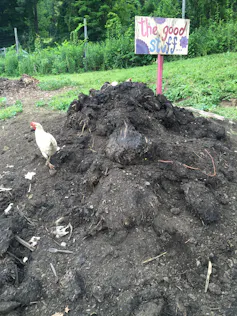 A compost pile at the Isabella Freedman Jewish Retreat Center. Adrienne Krone
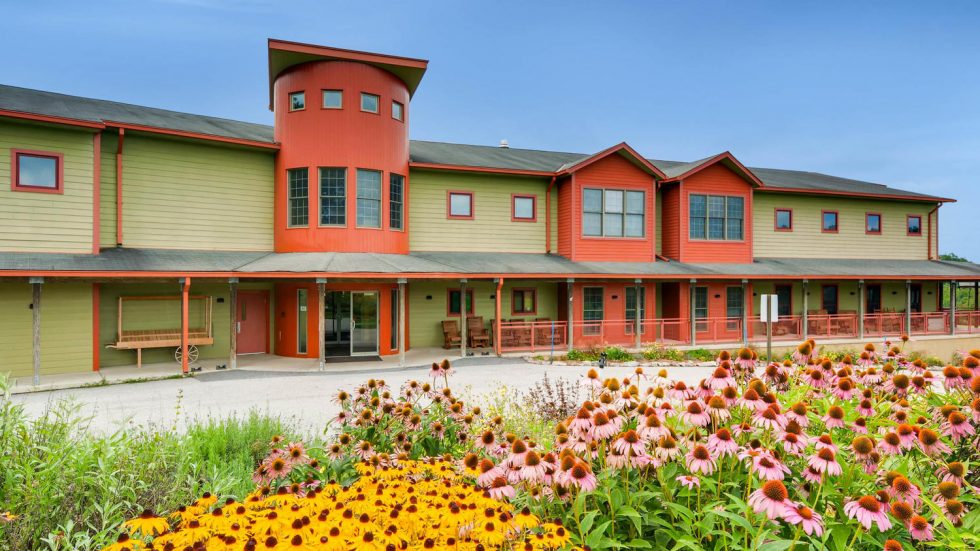
At the Isabella Freedman Jewish Retreat Center in Falls Village, Connecticut, I worked alongside young Jewish adults participating in a three-month program, the Adamah Farm Fellowship, as they planted, harvested and prepared produce for their weekly community supported agriculture program. The fellows begin their days with a morning prayer session and take time away from their work on the farm to celebrate Shabbat together. The fellows also attend classes where they learn about the biblical laws and ethical concepts related to agriculture, alongside scientific research on sustainable agriculture.
I conducted my fieldwork during a “shmita” year, a year of rest for the land. Just as the Hebrew Bible instructed Jews to work for six days and rest on Shabbat, the seventh day, they were also instructed to work their land for six years and then let it rest in the seventh year, the shmita year.
Farms took different approaches to the “shmita” year: The Adamah Farm Fellows kept their fields in production and started a community garden to mark their observance of the “shmita” year.
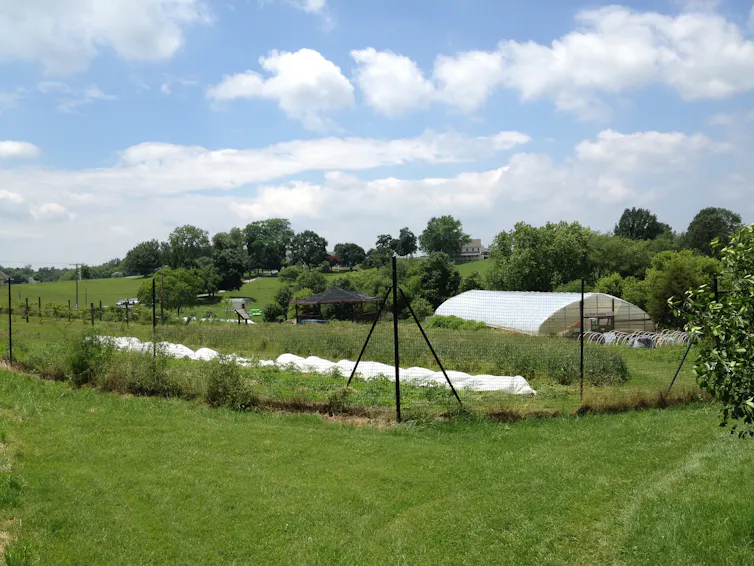 The farm at the Pearlstone retreat in Reisterstown, Md., during the ‘shmita’ year. Adrienne Krone
At the Pearlstone center in Reisterstown, Maryland, the farmers replaced their usual rows of vegetables with cover crops that would enrich the soil during its year of rest. They also canceled their community supported agriculture program and focused their educational programs on the Jewish texts and traditions of “shmita” and the importance of rest for all beings.
The Hallelujah Diet
Another group I studied were followers of the Hallelujah Diet, a plant-based diet rooted in the biblical story of the Garden of Eden…
This article was originally published in The Conversation. You can read the entire article here.