


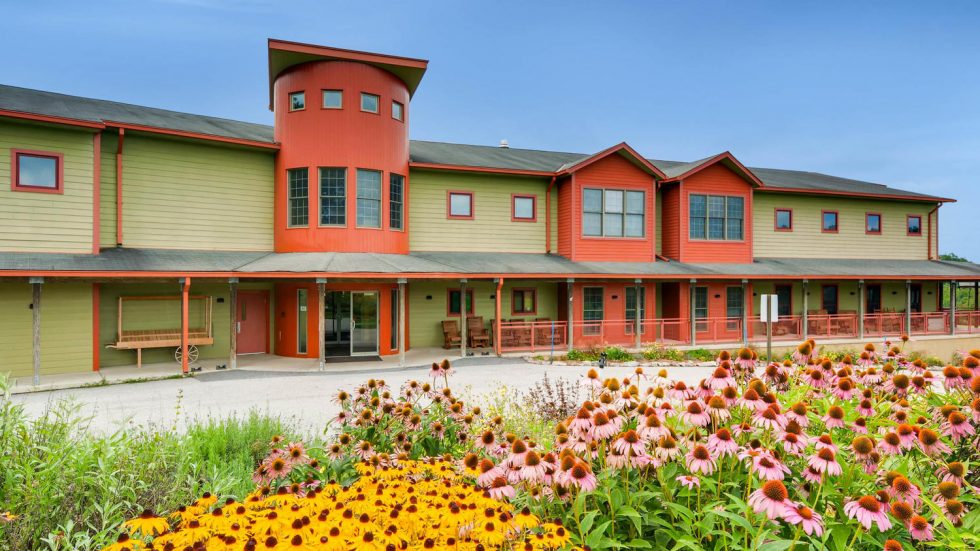


 Kids at the Strawberry Festival at Pearlstone. (Courtesy of Pearlstone)
At Pearlstone, a sprawling outdoor campus in Reisterstown that serves as Adamah’s headquarters, there’s a program that welcomes Baltimoreans to participate in activities in the natural world that are rooted in Jewish tradition.
This is the second iteration of Pearlstone’s Sundays on the Farm series. The first existed pre-pandemic and ended in 2020.
When the program was revived last year, it was a breath of fresh air for all involved, and they haven’t slowed down since, said Pearlstone Senior Program Director Ashley Pressman.
“Our very first one was in March [2025] and it was something we did going into Passover, where we were doing a wheat-to-matzah program and different natural crafts,” Pressman said. “From that we have evolved with different themes. There’s always a theme that ties both to the Jewish calendar and also where we are in the seasons.”
Sundays on the Farm includes a Harvest Music Festival coming in October. There’s a Chanukah edition coming this winter, where attendees can build dreidels and menorahs out of repurposed waste and natural materials. This spring, there was a sheep and wool festival and in the summer a blueberry festival.
Pearlstone varies events and themes, but all are centered on the idea of combining Jewish values and practice with nature. This combination attracts people from both ends of the spectrum and helps them become more acquainted with the other if they so choose.
 Pearlstone celebrated Lag b’Omer with a scavenger hunt. (Courtesy of Pearlstone)
“I think the goal was always to make sure that Pearlstone does programming that is low-barrier, that is low-cost, that’s easy-access and doesn’t require a big commitment, and to make sure that we had opportunities [for people] to come out to the campus and celebrate Judaism and nature together,” Pressman said.
Sundays on the Farm events see some who come each session, as well as one-off guests who were specifically attracted to one event. Pressman said word has continued to spread since last spring and events are well attended regardless of their content.
“We see folks that are definitely our regulars, and we love seeing them every time we do a program, and then it’s great to see the people who are coming out because, you know, we brought in a band that they’re really interested in,” Pressman said.
In addition to its festival or fair-type events, Pearlstone added what it is calling “deep dive workshops” this year. Those are typically hour-long sessions where attendees learn from an educator on things like natural wool dyeing or blueberry propagation.
Many of the attendees at Sundays on the Farm are families with children who benefit from time spent running around and getting their hands dirty outside.
“They get to maybe do something over the fire, they might get to do tie-dyeing. They might get to do different kinds of eco-crafts and just be out and playing in the open green space. We hear a lot from parents [who say] that’s one of the reasons they come out,” Pressman said. “Their kids just absolutely love to be out there doing different things, from running around and playing with the sports equipment to whatever [is] the most creative and challenging thing.”
Pressman said that the value of Sundays on the Farm is more than just a nice activity or family time — the series connects people to their Jewish identity and tradition. That’s invaluable in a world that is so centered around morning commutes, screen time and air conditioning.
“We often think of Judaism as being the people of the book. Before we were the people of the book, we were the people of the land, and we are still the people of the land. Jewish tradition is very much an agricultural tradition, and I think that helping people reengage with that and reconnect with that is something that a lot of Americans don’t get to do, because we live in cities, we live in suburbs,” she said. “We don’t always get a chance to really understand how deeply our people are connected to the land.”
Read the article on Baltimore Jewish Times.